Is Safety Training Helpful?

mailto
February 8th, 2010| by Dr. Saraf |

Workplace Safety training is a big industry…every year companies are spending millions of dollars on training their employees.

I have always doubted the efficacy of repetitive and boring training sessions whether personal or virtual (Will your Refresher Training Work?). What is more surprising is that organizations are increasing their training budget without evaluating efficacy of their training program.

NIOSH recently released a report regarding Occupational Health and Safety (OHS) training supporting this view (A Systematic Review of the Effectiveness of Training & Education for the Protection of Workers).

I would like to highlight one of the key conclusions regarding engagement during training sessions.

“There is insufficient evidence to determine whether a single session of high engagement training has a greater impact compared to a single session of low/medium engagement training.”

We all agree dull training sessions will never create the desired impact…but a great training session may not sufficient either. This is especially true for workplace safety training which often is intended to modify behavior/habits and is more than merely a knowledge imparting exercise.

You need to have regular follow up mechanisms in order to get to the desired results.

For the benefit of other readers, please share strategies you are currently using to increase safety training effectiveness.

Exploding Concrete

mailto
February 1st, 2010| by Dr. Saraf |

I recently came across a very interesting incident involving foam concrete.

Foam concrete is produced by mechanical mixing of foam prepared in advance with concrete mixture, and not with the help of chemical reactions. At the incident site, two workers were removing steelwork using angle grinders while the foam concrete was settling. There was an explosion injuring the two workers.

Foam concrete produces hydrogen which is highly flammable.

To know more about foam concrete hazards, click on the link below.

Health and Safety Alert on Foam Concrete Fire Hazards

OSHA Combustible Dust Rulemaking

mailto
January 28th, 2010| by Dr. Saraf |

Stakeholder Comments on OSHA Combustible Rulemaking from John Astad’s blog.

Biodiesel Incidents Trend

mailto
January 26th, 2010| by Dr. Saraf |

Based on incident data in biodiesel facilities, I had written that the biodiesel industry in the US is experiencing an incident every two-and-a-half months, i.e. approx. 10 weeks.

Here are incidents following my May 2009 blog post on biodiesel incident frequency.

1.       15 July 2009, Chicago: An explosion at a biodiesel plant in Chicago injuring two workers.

9-weeks later…

2.       24 September, 2009, Florida: a fire was reported in a biodisel plant near Osceola County in Florida. There were no fatalities or injuries.

10-weeks later…

3.       4 December, 2009, Seattle: A glycerin tank was over pressurized leading to equipment damage at Imperium Renewables’ biodiesel plant in Seattle.

Isn’t it high time for biofuel industry to wake up to these incidents?

In the coming year biodiesel production is expected to reduce due to (a) reduced oil prices and (b) expiration of $1 credit for every gallon. With reduced production, I expect reduction in incidents.

Near-Miss(es)!!!

mailto
January 23rd, 2010| by Dr. Saraf |

A friend of mine, Dr. Ben Thomas, recently forwarded me a video showing a man escaping incident in matter of seconds.

Note: The video is probably not real as indicated by comments below it but if it is the person in the video is indeed very very lucky.

Is Workplace Safety Merely Common Sense?

mailto
January 7th, 2010| by Dr. Saraf |

Surprisingly, many organization and professionals believe that safety can be achieved by common sense. Here is an excellent article from Kevin Jones’ Safety at Work blog about common sense and safety:

Safety is More Than Common Sense

Did Trees Contribute To Buncefield Explosions?

mailto
January 4th, 2010| by Dr. Saraf |

Recently, Erik, a reader of this blog directed me to a video his firm has created that explains the role of trees leading to the Buncefield explosion.

Remember the Buncefield incident occurred in oil storage and transport depot. Thus the fuel involved was liquid hydrocarbon. The most probable outcome of a liquid hydrocarbon release is a fire…so it is conceivable that other circumstances such as amount and duration of release and the semi-confinement provided by surroundings may have lead to flame acceleration and increased explosion overpressures.

Here’s a link to the video from Gexcon.

Top Five Risk and Safety Blog Posts for 2009

mailto
December 31st, 2009| by Dr. Saraf |

I would like to wish readers and the growing list of subscribers of risk and safety blog a prosperous 2010.

It has been a year since I started writing the blog. Here are top five blog posts for 2009:

1. Biofuel Safety: Is it time for Bio-PSM?

2. Lithium Battery Fires: Why Your Laptops Can Catch on Fire

3. Top Five Challenges for Process Safety

4. BLEVE

5. Quantitative Risk Assessment: Will Quantifying Risks Help You Minimize Them?

I hope readers have found Risk and Safety blog informative and I look forward to continuing this work in the coming here.

If you have any feedback/comments/suggestions for improvement do drop me a note.

History Repeats Itself: Buncefield, Puerto Rico, Jaipur

mailto
November 5th, 2009| by Dr. Saraf |

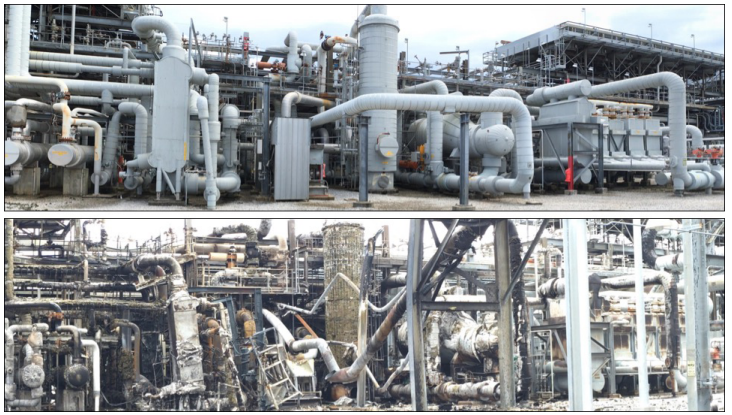
In December 2005, fire and explosion at Buncefield oil storage depot injured 40 people. Overfilling of a fuel storage tank (Tank 912) led to release of unleaded gasoline (petrol) which formed a cloud of flammable vapor that subsequently ignited. 

Puerto Rico Fire

Four years after Buncefield, around midnight on October 23, 2009, a major fire was reported at the Caribbean Petroleum Corporation (CBC) oil depot in San Juan Bay, Puerto Rico. The initial fire destroyed eleven storage tanks at the facility and the fire spread to adjacent tanks. The explosion was heard 5-miles away. The tanks contained jet fuel, oil, and bunker fuel. 

Click here for further details on CBC fire and explosion.

Jaipur Fire

Exactly a week after the San Juan fire on October 29, a fire broke out at Indian Oil Company (IOCL) storage depot in Jaipur, India. Six people have been killed and 150 are reported injured. The fire lasted for around six days and neighboring residents are complaining of health problems. IOCL is facing negligence charges.

Click here for further details on Jaipue fire and explosion.

Fires in Storage Facilities

It is worth nothing that all the above three major incidents (Buncefield, San Juan, and Jaipur) occurred in a matter of four years at liquid hydrocarbon storage facilities .

Why does history repeat itself…and in such a short time? 

Terrorism Risk Insurance Act Exclusions: Gray Coverage Areas

mailto
October 28th, 2009| by Dr. Saraf |

The U.S. Government has extended the Terrorism Risk Insurance Act (TRIA) to 2014. TRIA is intended to support insurance companies in case the claims from a terror incident go above a certain threshold.

What is interesting are the exclusions used by the government for this reinsurance.

Domestic vs. International Terrorism

Insured losses are covered under TRIA only if the event is certified by the Treasury Secretary is a foreign act of terrorism

Thus, TRIA-type policy would not cover  an event like the 1995 Oklahoma City bombing since it would be considered domestic terrorism.

What if the terror incident was committed by  a citizen acting on behalf of a foreign person? For example, the 2005 London bombing were attributed to UK citizens and Pakitan citizens. If this were to occur in the U.S., will it qualify for TRIA coverage?

Chemical, Biological, Radiological, and Nuclear (CBRN) Terrorist Attacks

Losses resulting from CBRN are covered by TRIA only if such perils are specifically covered in the original property and business interruption insurance policy. Typically, this is not the case.

The above exclusions represent significant uncertainties  in terms of TRIA-coverage and can hurt the insurance agencies. Is the government being smart about the exclusions? What can I say…the house always wins!!!